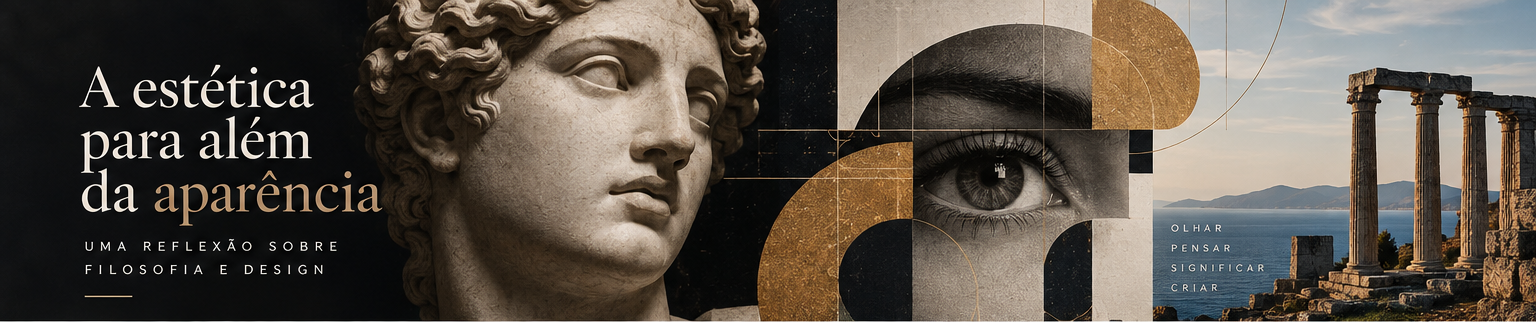
What is beauty? Is it what pleases the eye, or what somehow awakens in us a more authentic and profound sense of meaning?
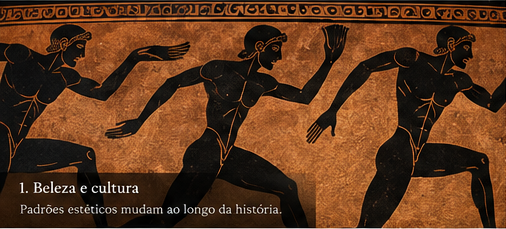
To reflect on beauty is to recognise that our aesthetic perception is not isolated from the world. What we consider beautiful carries cultural, historical and social influences. Over the centuries, different civilisations have established their own ways of understanding and representing beauty, demonstrating that aesthetic standards are not necessarily permanent or universal.
Beauty in Philosophy: beyond appearances
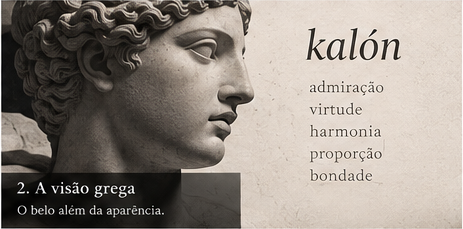
In Ancient Greece, we find reflections that go beyond mere appearance. The Greek word kalón, often associated with beauty, could also express what is noble, admirable or morally worthy. In Greek philosophical thought, beauty was not necessarily confined to the visual realm; in different contexts, it was connected to ideas of virtue, harmony, proportion and goodness.
In The Republic, through the dialogue between Socrates and Glaucon, Plato offers a particularly interesting reflection on the distinction between beautiful things and beauty itself:
Socrates — But are those who are capable of rising to the essence of beauty itself not rare?
Glaucon — Quite rare.
Socrates — Does someone who knows beautiful things, but does not know beauty in its essence and cannot follow those who might lead them to this knowledge, seem to you to be dreaming or awake? Consider this: whether asleep or awake, is dreaming not taking the appearance of a thing for the thing itself?
Plato, The Republic, Book V, 476b–c. English rendering of the passage quoted in the Portuguese article.
Plato’s questioning invites us to consider the difference between recognising manifestations of beauty and investigating their foundations. While aesthetic standards may vary across periods and cultures, Plato presents an inquiry into Beauty itself, understood beyond particular appearances.
Although this reflection belongs to a philosophical context different from the one in which contemporary design develops, we can establish an interesting relationship between the two.
This understanding leads us to a particularly interesting question: does everything that is visually pleasing necessarily have meaning?
In the field of design, I consider this question fundamental.
Beauty, meaning and the challenges of contemporary design
We live surrounded by images, symbols and visual expressions that constantly compete for our attention. Yet what makes an immediate impression does not always establish a lasting relationship with the viewer.
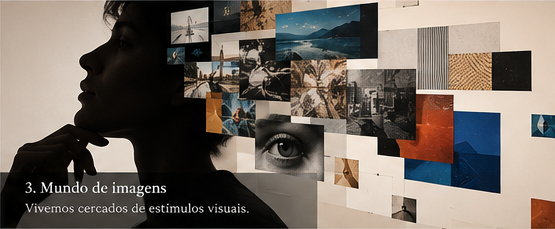
This becomes even more evident at a time when creative processes are being accelerated by technological transformations, such as Artificial Intelligence (AI), which greatly expands the possibilities for creating and producing images.
But amid so many possibilities, another question arises: does producing images more quickly necessarily mean creating identities with greater depth?

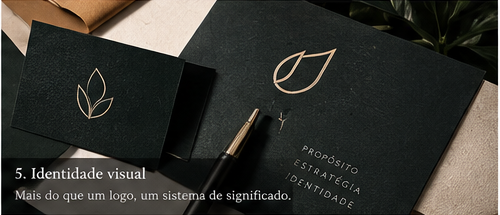
A visual identity may follow the aesthetic trends of a particular period, feature sophisticated colours and carefully crafted typography, but if there is no coherence between its expression and what the brand represents, its communication may remain superficial.
This is where I understand design as something that goes beyond ornamentation. After all, when a visual identity is developed without a conceptual logic to support it, it risks becoming just one more among the many already present in the market. The brand may end up losing what should make it distinctive: the ability to be recognised for its own personality.
Designing an identity requires investigating concepts, understanding contexts and establishing relationships between form, function and meaning. Beauty is part of this process, but it should not be its only foundation.
After all, what we consider visually contemporary today may take on a different interpretation in the future. We need only look at the many graphic trends that shaped previous decades and that, interestingly, return to the present scene, reinterpreted and driven by new cultural and market movements.
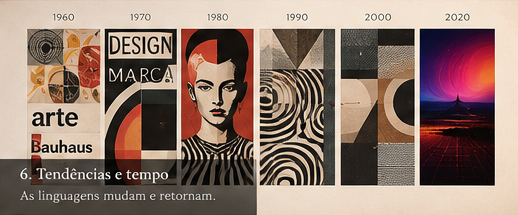
Visual languages change, cultural repertoires evolve, and our way of perceiving the world follows these changes.
That is why I believe a visual identity should not emerge exclusively from the pursuit of beauty, but from an investigation into what it needs to communicate.
Beauty can attract the eye. Meaning, however, gives us reasons to remember an image.
Perhaps this is one of the most interesting relationships between Philosophy and Design: each, through different paths, can lead us to question what we perceive, investigate the reasons behind it and discover new possibilities for interpretation.
Before asking what a brand should look like, we need to understand what it wishes to represent.
From thought to expression: three movements in my creative process
It is precisely from this reflection that I organise three fundamental movements in my creative process:
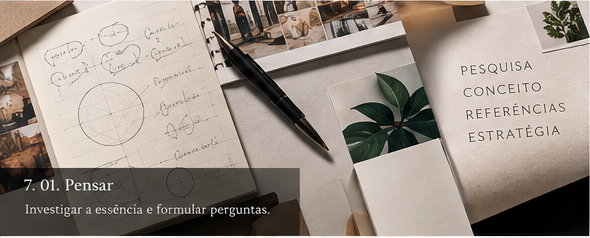
01. Think
Investigate the essence, understand the context and formulate questions that help identify a brand’s foundations. Before seeking visual answers, I consider it necessary to understand the problem and its different possibilities for interpretation.
This movement involves observing, researching and questioning. It is the moment to understand a brand’s journey, its values, its audience and the challenges that guide its communication.
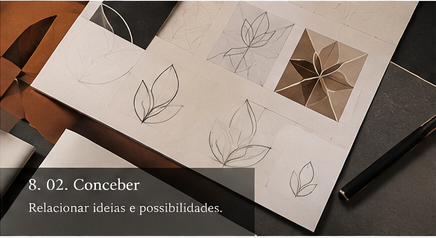
02. Conceive
Connect concepts, ideas and references, transforming the initial investigation into creative possibilities. This is when ideation gathers momentum, allowing us to explore paths and establish a conceptual direction for the project.
Conception requires making connections between different bodies of knowledge and references, experimenting with alternatives and recognising which solutions are most coherent with the objectives identified during the investigation.
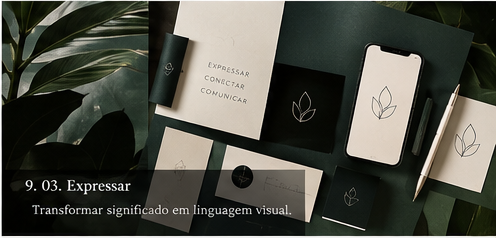
03. Express
Transform concepts and meanings into a coherent visual language. Colours, typography, shapes and graphic elements become part of an identity system capable of communicating the brand’s personality and values.
In this movement, ideas take material form. Visual expression becomes more than an aesthetic choice: it becomes an intentional construction in which every element contributes to the unity and recognition of the identity.
Philosophy and Design in building a brand with a distinct identity
These three movements form important foundations that I consider throughout my creative process. Along the way, I also use Philosophy as a tool for investigation and reflection.
After all, who said Philosophy must remain confined to academic treatises or the dusty books on our shelves?
Philosophical thought is still present in the way we observe, question, interpret and transform reality. Why not recognise its contribution to the creative world as well?
In an increasingly digital world, where technological tools make it possible to produce countless visual solutions in moments, I believe the true distinction lies not only in the ability to create, but also in the depth of the thinking that underpins each creation.
Building a brand with purpose and identity means seeking its own expression amid a universe of references, trends and often similar patterns.
Whether you run a small, medium-sized or large business, your brand has a journey, values and characteristics that deserve to be understood and communicated clearly.
Rather than simply following trends, we need to recognise what makes your business distinctive.
After all, before establishing a place in the market, a brand needs to understand the meaning it wants to build.
And if we began this reflection by asking what beauty is, perhaps we can end it with another question: what is the value of an image that impresses the eye if it cannot communicate what it truly represents?
It is precisely at this meeting point between thought, strategy and visual expression that I develop my work as an art director.
Jorge Araújo
Art Direction | Branding | Editorial Design
Discover how these principles take shape in my branding and editorial design projects and in my creative process.